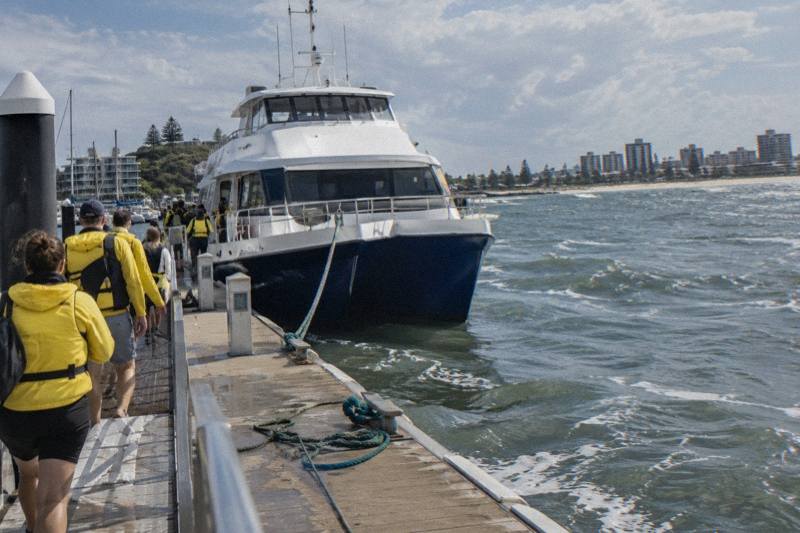
Is Whale Watching Ethical And How Close Do Boats Get?
Queensland law sets the distances: a 100 m no approach zone around a whale, a 300 m caution zone, 6 knots inside it, and separate limits for jet skis, aircraft, drones and swimmers. Here is what the rules allow and what to ask before booking.
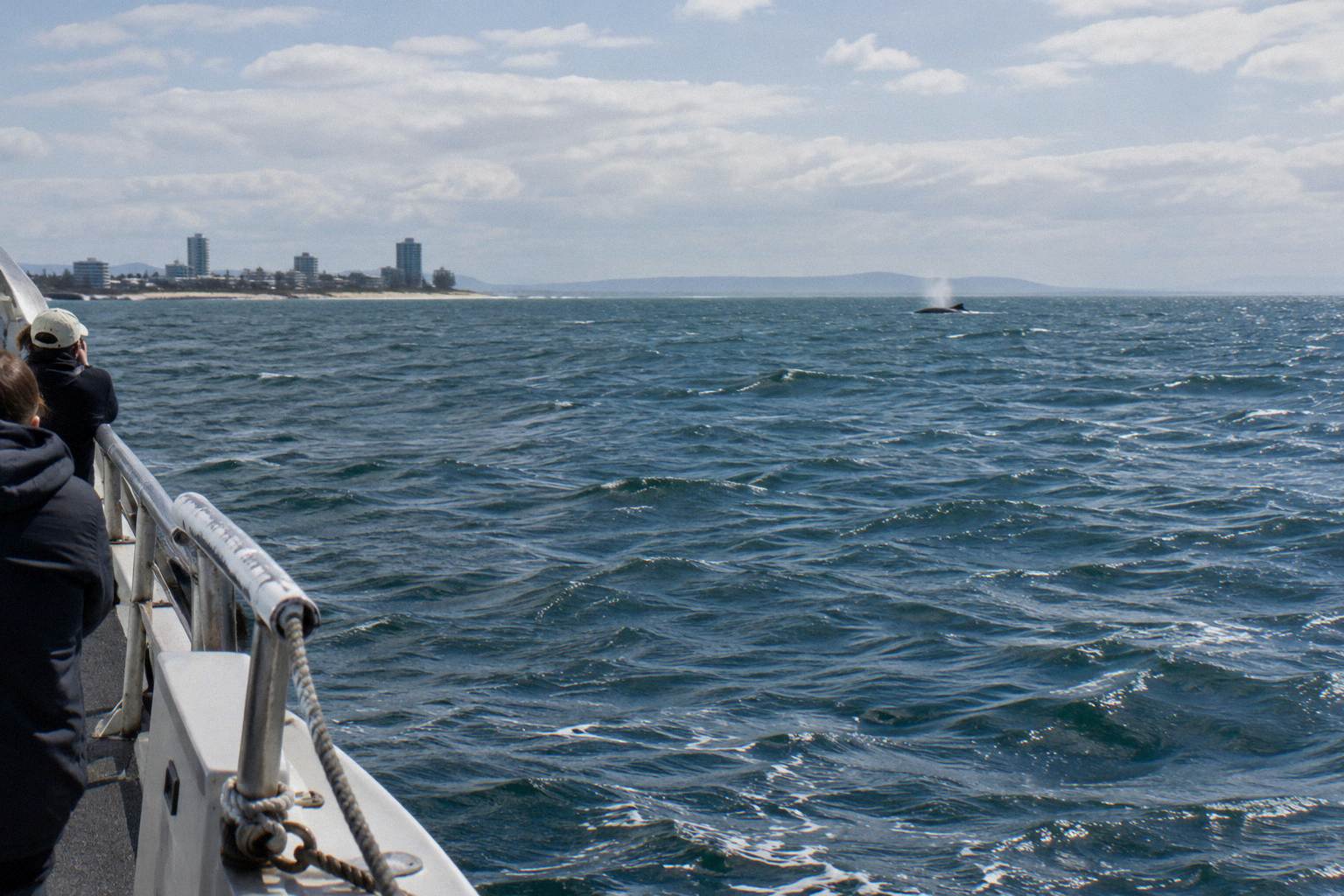
Yes, whale watching can be ethical when operators follow the law, and in Queensland the required distances are written into legislation. Boats must stay at least 100 m from a whale, travel at 6 knots with no wake inside the 300 m caution zone, and shut down or withdraw if a whale approaches them. Swimmers, jet skis, aircraft and drones each carry their own limits under Queensland and Commonwealth approach rules.
No one can certify a particular operator as ethical, and nothing here tries to. What can be stated plainly is the rulebook every commercial whale trip off the Queensland coast must work within, because those distances are not voluntary guidelines. They sit in the Nature Conservation (Animals) Regulation 2020, and breaching them is an offence. The Queensland Government's rules page and its marine mammal proximity brochure set out the numbers, and both are worth reading before you board any boat anywhere in the state.
The ethics conversation usually starts with distance, and that is where the law is clearest. A whale watching boat off Mooloolaba operates in state waters outside the Great Barrier Reef and Great Sandy marine parks, and the ordinary state approach distances apply there. There is also a national layer: the 2017 Australian National Guidelines for Whale and Dolphin Watching, which the Commonwealth publishes, and which swim programmes in particular are measured against. A reader weighing welfare concerns can hold any operator to both documents, and can ask directly which rules the trip follows and how the crew applies them on the water.
That questioning approach is more useful than a yes or no. Whale watching is legal, regulated and widely run along the whole east coast migration route, but the experience varies with how each crew behaves near an animal. The rest of the page lays out the exact distances by vehicle type, the engine and speed rules inside the zones, what the swim guidelines say, how permits work at Mooloolaba, and a short checklist of questions that sorts an operator who knows the rules from one who cannot quote them.
For readers who want the short version before the detail: the trips covered here from The Wharf Mooloolaba include the Sunreef 3-Hour Whale Cruise, from A$89 per person with a 4.3 rating from 200+ reviews, alongside Adventure Rafting's Fast Boat, Free Cancellation and Hydrophone Whale Adventure, both from A$115 per person. All amounts on the page are Australian dollars, and each of these three carries free cancellation (up to 24 hours before departure on most, up to 3 days on the Sunreef 3-Hour Whale Cruise and Swim With Humpback Whales) on the booking page.
What The Queensland Approach Rules Actually Say
Under Queensland rules, you must stay at least 100 m from a whale, or 300 m if you are in front of or behind the animal, and within a 300 m caution zone boats are limited to 6 knots with no wake. For dolphins, the distances are smaller: a 50 m no approach zone and a 150 m caution zone. These distances carry legal force under state regulation.
The Queensland Government states it directly: "The caution zone extends out to 300 metres from a whale, and 150 metres for a dolphin," and for the closer ring, "For a whale, the no approach zone is 100 metres and extends 300 metres in front of and behind the animal." The shape matters as much as the number. Because the protected space extends 300 m fore and aft, a boat crossing a whale's line of travel must plan around the animal's direction, not just its position. The underlying law is the Nature Conservation (Animals) Regulation 2020, which writes the 100 m and 300 m arcs into sections 281 and 282.
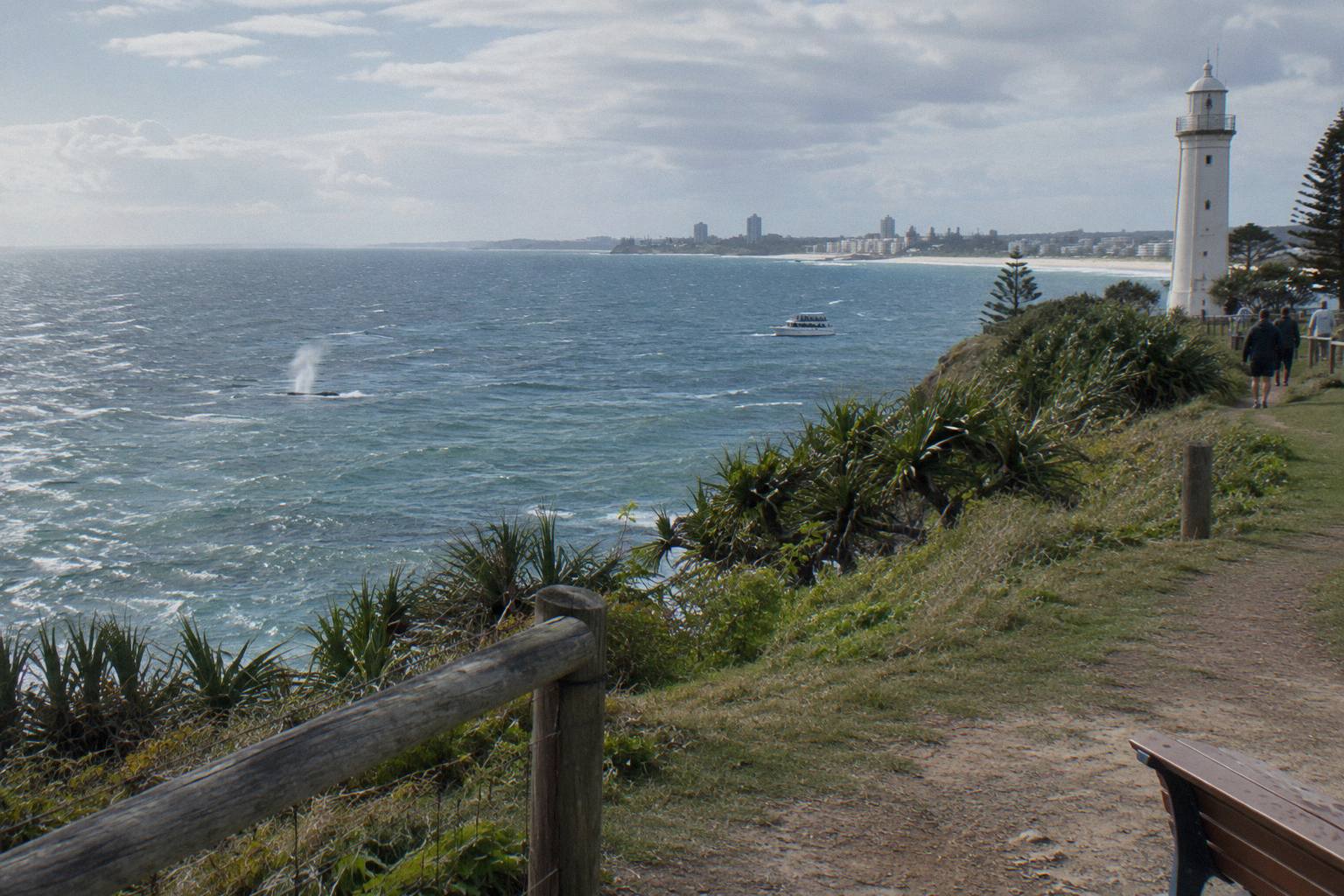
Speed is the second half of the rule. Inside the caution zone a vessel is limited to 6 knots with no wake, per the Queensland rules for watching marine mammals. A whale watching trip is therefore not a chase: once a boat is within 300 m of a whale it slows to a crawl, and the closer it sits to the no approach zone the less it may do. Operators must follow the Queensland and Commonwealth approach rules, and those are the limits a passenger can watch for from the deck.
The distances are not uniform for every type of craft and activity. The same Queensland rules page and the accompanying brochure set separate limits for jet skis, aircraft, drones and people in the water, and a white whale carries its own larger zone. The table below gathers them in one place.
| Activity or craft | Minimum distance from a whale | Source |
|---|---|---|
| Boat no approach zone | 100 m all round, extending 300 m in front of and behind | Queensland rules for watching marine mammals |
| Boat caution zone | Out to 300 m, 6 knots maximum, no wake | Queensland rules for watching marine mammals |
| Jet ski or hovercraft | Not within 300 m | Queensland rules and proximity brochure |
| Fixed wing aircraft | 300 m | Queensland rules and proximity brochure |
| Helicopter | 500 m, no hovering | Queensland rules and proximity brochure |
| Drone | Not within 100 m | Queensland rules and proximity brochure |
| Person in or entering the water | Not within 100 m | Queensland rules for watching marine mammals |
| White whale, such as Migaloo | 500 m no approach zone for boats | Queensland whales page |
The brochure version is the Queensland marine mammal proximity brochure, which lays out the same zones in diagram form and is the quickest document to check a claim against if a crew quotes a distance that sounds wrong.
What Happens When A Whale Approaches The Boat
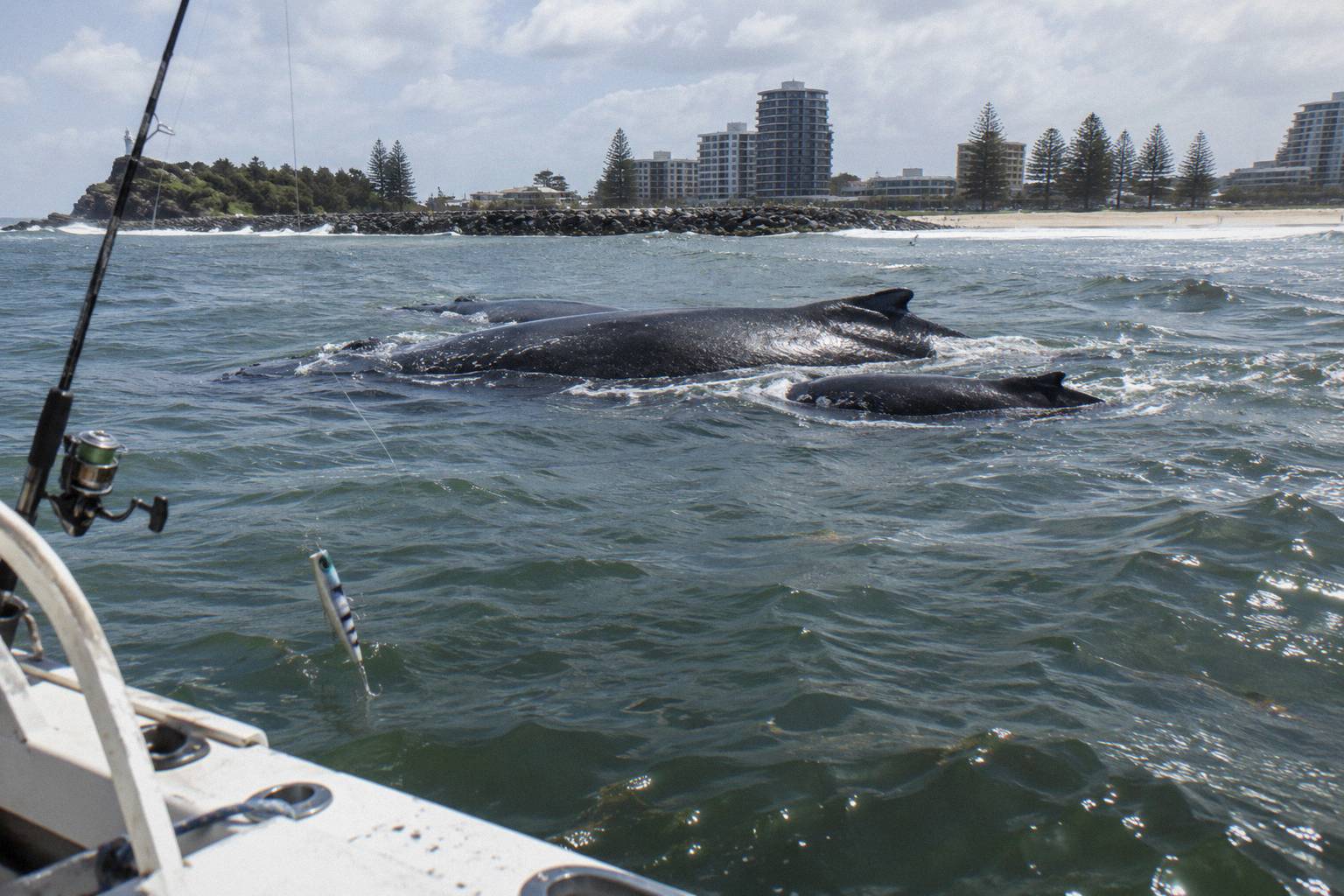
If a whale moves closer to the vessel, the rules shift onto the boat, not the animal. Inside the no approach zone the vessel must turn its engines off or disengage gears, or withdraw at under 6 knots without a wake, and inside the caution zone it may travel at no more than 6 knots. A whale choosing to come near a stopped boat is the one scenario where close views legally happen.
This is the part of the rulebook that answers the question people actually ask after a trip: how did the boat get that close without breaking the law. The answer is that it usually did not get close at all. The whale did. Queensland's rule reverses the burden: a boat that finds itself inside the 100 m zone because the whale moved must shut down or slide away slowly, and the Queensland Government's whale watching guidance states this plainly. The whale controls the encounter; the boat controls its engines.
For a passenger weighing welfare, the engine rule is the visible test. A boat that keeps its distance and slows or stops when a whale closes is operating the way the regulation intends. A boat that circles, speeds inside the caution zone or holds position ahead of a travelling whale is not, and the 6 knot and no wake limits give an observer something concrete to measure against. No fact available here speaks to how any named operator behaves in a given encounter, so the practical step is to ask the operator, before booking, how the crew handles an approach and what its standard practice is when whales are close.
White whales get special treatment, and the Queensland whales page explains why. A humpback more than 90 percent white, Migaloo being the known example, carries a 500 m no approach zone for boats and 610 m for aircraft, and the same page notes white whale sightings are rare and not guaranteed each season. No trip can promise one, and the extra distance exists precisely so that a rare animal is not crowded. Distance rules aside, a breaching humpback remains one of the most debated sights on the water, and the guide to why humpback whales breach covers what scientists actually know.
Do Calves And Pods With Calves Have Extra Protection?
The distinction matters because it is often muddled. A reader who has read about a 300 m calf rule and expects it to govern a Mooloolaba trip would be wrong about which waters it covers. The Queensland brochure places the whale-with-calf distance in the Great Barrier Reef Marine Park and other Commonwealth waters, and the Queensland regulation sets no equivalent separate calf distance for ordinary vessels in the state waters where Mooloolaba's boats run. Stating that carefully is not a loophole; it is the actual law.
The national guideline layer is where calf caution is stated for everywhere else. The Australian National Guidelines for Whale and Dolphin Watching 2017 say vessels must not enter the caution zone when a calf is present, defining a calf as an animal less than half its mother's length, and that swimming should not occur with whale or dolphin calves or pods containing calves. Sunreef states on its own page that its swim encounters follow the Australian National Guidelines for Whale and Dolphin Watching, which is the operator's own statement about its programme.
For a reader deciding what to book, the calf rules are the sharpest question in the checklist. Asking an operator what the crew does when a mother and calf appear, and whether the trip withdraws in that situation, tests whether the guidelines are a live practice or a paragraph on a website. The answer belongs to the operator; the standards to compare it against are the ones quoted above.
What About Swimming With Whales?
A person in or entering the water must not be within 100 m of a whale, or 50 m of a dolphin, and that rule sits in Queensland law as an offence. The 2017 national guidelines allow authorised swim programmes a different regime, including no closer than 30 m to any whale or dolphin, and state that swimming must not occur with calves or pods containing calves. Swim programmes are run by operators, and the operator's own rules apply.
No Queensland instrument was found that authorises or sets conditions, such as swimmer numbers or line length, for a Mooloolaba swim programme, and nothing here claims one exists. What can be said is twofold. First, the default in water rule is the 100 m distance in the Queensland rules, which the regulation makes an offence to breach. Second, the Commonwealth guidelines set out how an authorised swim programme may operate: swimmers must not enter the water closer than 100 m to a whale and must not approach closer than 30 m to any whale or dolphin.
The one Mooloolaba swim product in the trip range is Swim With Humpback Whales, run by Sunreef with Whale One, from A$269 per person for a 4 hour trip from The Wharf Mooloolaba, with free cancellation up to 3 days on the booking page. Sunreef's own statement is that its swim season runs July to mid October and that encounters follow the Australian National Guidelines for Whale and Dolphin Watching. Those are the operator's words about its own programme, and they are the right ones to quote rather than any paraphrase.
Readers weighing the swim question can go deeper on the rules and safety picture for swim with whales trips, and on the trade offs in choosing between a whale cruise and a swim trip. The welfare lens for a swim trip is the same as for a boat trip: the national guideline limits, the calf prohibition, and how openly the operator explains its in-water practice before you pay.
One Mooloolaba option markets itself on listening rather than proximity: the Hydrophone Whale Adventure, a 2 hour trip from The Wharf Mooloolaba from A$115 per person, with free cancellation up to 24 hours on the booking page. It runs under the same state approach distances as every other boat.
Do Sunshine Coast Whale Boat Operators Need A Permit?
This surprises people who assume a licence implies oversight of welfare. The permit question and the ethics question are separate. The Queensland environment department's page on commercial whale watching states the position in one line: a permit is not required in state waters outside marine parks. What still binds every operator, permitted or not, is the approach regulation itself: the distances, speeds and engine rules in the Nature Conservation (Animals) Regulation 2020 apply in state waters regardless of any permit.
The practical takeaway for a reader is not that Mooloolaba trips are unregulated. It is that the regulation to ask about is the approach rules, not a permit number. An operator mentioning compliance with the Queensland and Commonwealth approach rules is talking about the instrument that actually governs the trip's behaviour near whales. An operator who cannot name the distances in the table earlier is the one to book elsewhere from.
How To Pick A Trip When Welfare Is Your Concern
Choose on behaviour, not slogans: ask how the crew applies the 100 m and 300 m zones, what it does when a whale approaches or a calf appears, and whether the trip's marketing quotes distances at all. Every trip covered here departs under the same state approach rules, so the differences that matter are duration, price, group size where stated, and the answers the operator gives before you pay.
The three Mooloolaba cruise options most often compared are the Sunreef 3-Hour Whale Cruise, from A$89 per person, rated 4.3 from 200+ reviews; Fast Boat, Free Cancellation, from A$115 per person, rated 4.6 from 100+ reviews; and Sunshine Coast Afloat, 3 Hours, from A$105 per person, rated 4.8 from 136 reviews. All three carry free cancellation on the booking page. Duration differs, two hours against three, and Adventure Rafting states a maximum of 20 guests on its own trips; no group size figure is published for the others, so ask the operator.
| Trip | Duration | From price per person | Departure point |
|---|---|---|---|
| Sunreef 3-Hour Whale Cruise | 3 hours | from A$89 | Sunreef Mooloolaba, 11-12/123 Parkyn Parade |
| Fast Boat, Free Cancellation | 2 hours | from A$115 | The Wharf Mooloolaba |
| Hydrophone Whale Adventure | 2 hours | from A$115 | The Wharf Mooloolaba, marina side jetty next to Prawn Star |
| Sunshine Coast Afloat, 3 Hours | 3 hours | from A$105 | 21 Parkyn Parade, Mooloolaba |
| Coastal Express Small Boat | 2 hours | ask the operator | The Wharf Mooloolaba, 123 Parkyn Parade |
| Swim With Humpback Whales | 4 hours | from A$269 | The Wharf Mooloolaba, 123 Parkyn Parade |
Every one of those trips runs under the same approach distances set out earlier. When the decision is about format rather than operator, the pages on small group versus large boat whale watching and how much a whale watching trip costs on the Sunshine Coast break the trade offs down further. If a close view is the goal, remember the law's design: the closest legal encounters happen when a whale chooses to approach a stopped boat, which is why the Mooloolaba Whale Watching question is never how close the boat can push in, but how it behaves when the whale comes to it.
For a first trip that keeps the decision simple, the 3 hour cruise format gives the longest time on the water among the standard Mooloolaba options at the lowest from price, and it is the trip most of the season's bookings are built around.
If two hours suits better, Fast Boat, Free Cancellation covers the same waters on a shorter format, and Adventure Rafting states a 20 guest maximum and an onboard toilet on its own trips, with its booking page advising arrival 30 minutes before sailing because parking can be difficult during peak times. Time limited parking at The Wharf means allowing extra time in peak season is wise for any departure there.
Questions Worth Asking An Operator Before You Book
Ask four things: which approach distances the crew works to and whether it can quote them; what the boat does when a whale closes inside 100 m; what happens when a mother and calf appear; and what the cancellation and sighting policies are in plain words. An operator who answers from the rulebook is easier to trust than one who answers in slogans, and each answer is checkable against the sources above.
The checklist works because every item has a stated standard behind it. The distances are in the Queensland rules page and brochure. The engine and speed behaviour is in the Queensland whale watching guidance. The calf practice is in the 2017 national guidelines. The cancellation terms are on each booking page, and every trip in the range here carries free cancellation, with Whale One's own policy on its Sunreef run trips being a free return trip if no whales are seen, while Adventure Rafting says on its page it cannot guarantee sightings. Those are the operators' own statements, quoted as theirs, and they are the sort of direct answers a welfare minded reader should expect on the other three questions too. Knowing what the whales themselves are likely doing out there helps too, and the guide to humpback behaviour on a Mooloolaba cruise covers breaches, tail slaps and spy-hops before you head out.
Two cautions round out the asking. First, treat any promise of a particular behaviour from the whales, a breach, a close pass, a specific animal, as marketing rather than ethics, because no operator controls what a wild whale does. Second, a rating is not a welfare audit. A trip rated 4.8 from 45 reviews tells you what 45 guests thought of their morning, no more, and review counts sit beside their ratings for that reason.
Common Mistakes When Judging A Whale Trip's Ethics
The frequent errors are assuming one distance rule covers every water, quoting the Reef's 300 m calf limit as if it governs Mooloolaba, believing a permit proves good practice when none is required outside marine parks, taking a sighting promise as a welfare signal, and forgetting that swimmers, jet skis and drones carry entirely different limits. Each mistake is avoidable by checking the actual Queensland rules before booking rather than after.
The calf mistake is the most common. The 300 m whale-with-calf distance belongs to the Great Barrier Reef Marine Park and Commonwealth waters, not to the state waters off Mooloolaba, while the national guideline against entering a caution zone with a calf present is a guideline rather than that state rule. Mixing them up leads readers to accuse or trust operators on the wrong basis.
And the permit mistake gives false comfort: with no permit required outside marine parks, the real compliance question is the approach regulation, so ask about distances, not licences.
Any of those three is a reasonable starting point from The Wharf Mooloolaba, each with free cancellation on the booking page, and each following the same approach distances.
Common Questions About Whale Watching Ethics And Approach Distances
Is Whale Watching Ethical And How Close Do Boats Get?
Whale watching is legal and regulated, and the ethics come down to whether the operator follows the approach rules. Queensland law sets a 100 m no approach zone around a whale, extending 300 m in front of and behind, a 300 m caution zone with a 6 knot and no wake limit, and separate distances for jet skis, aircraft, drones and swimmers. Operators must follow the Queensland and Commonwealth approach rules.
How Close Can A Boat Legally Get To A Whale In Queensland?
A boat must keep at least 100 m from a whale in all directions, and the zone extends 300 m ahead of and behind the animal. Within 300 m, the caution zone, the boat is limited to 6 knots with no wake. If a whale approaches closer, the boat must turn its engines off or disengage gears, or withdraw at under 6 knots without a wake.
Do Whale Watching Boats Need A Permit At Mooloolaba?
No. The Queensland environment department states that a permit is not required to conduct a commercial whale watching activity in state waters outside marine parks, and Mooloolaba is outside both the Moreton Bay and Great Sandy marine parks. The approach rules still apply to every operator.
Is There A Special Rule For Whales With Calves?
The 300 m distance for boats near a whale with a calf applies in the Great Barrier Reef Marine Park and other Commonwealth waters, not as a separate state rule off Mooloolaba. The 2017 national guidelines say vessels should not enter a caution zone when a calf is present and that swimming should not occur with calves or pods containing calves.
Can You Swim Closer To A Whale Than A Boat Can?
No. The default Queensland rule is that a person in or entering the water must not be within 100 m of a whale. The 2017 national guidelines allow authorised swim programmes a different regime, including no closer than 30 m to any whale or dolphin, but swim programmes are run by operators and the operator's own rules apply.
Does A Sighting Promise Mean A Trip Is More Ethical?
No. A promise like that is a commercial policy about what happens if no whales appear, not a statement about how the boat behaves near whales. Neither statement measures welfare practice.