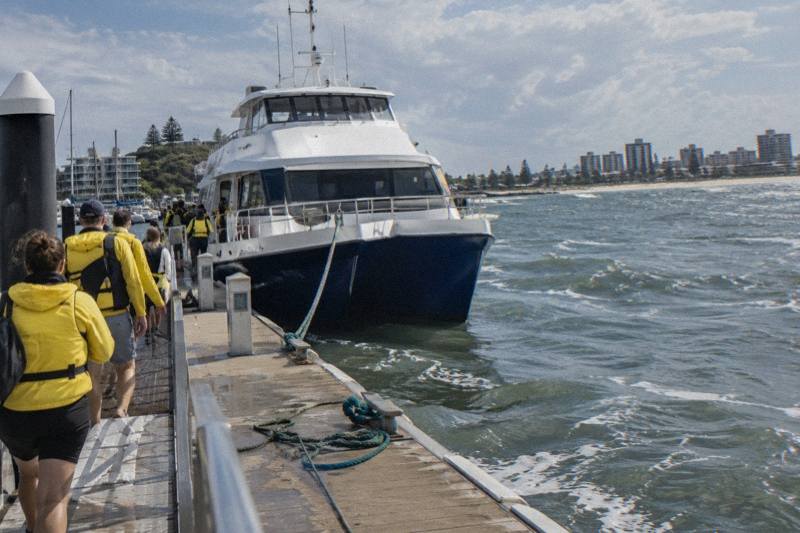
Sunshine Coast Whale Season: What Each Month Looks Like On The Water
Fixing dates is the first real decision in a whale trip, and the season runs roughly June to October, into early November, depending on which source you read.
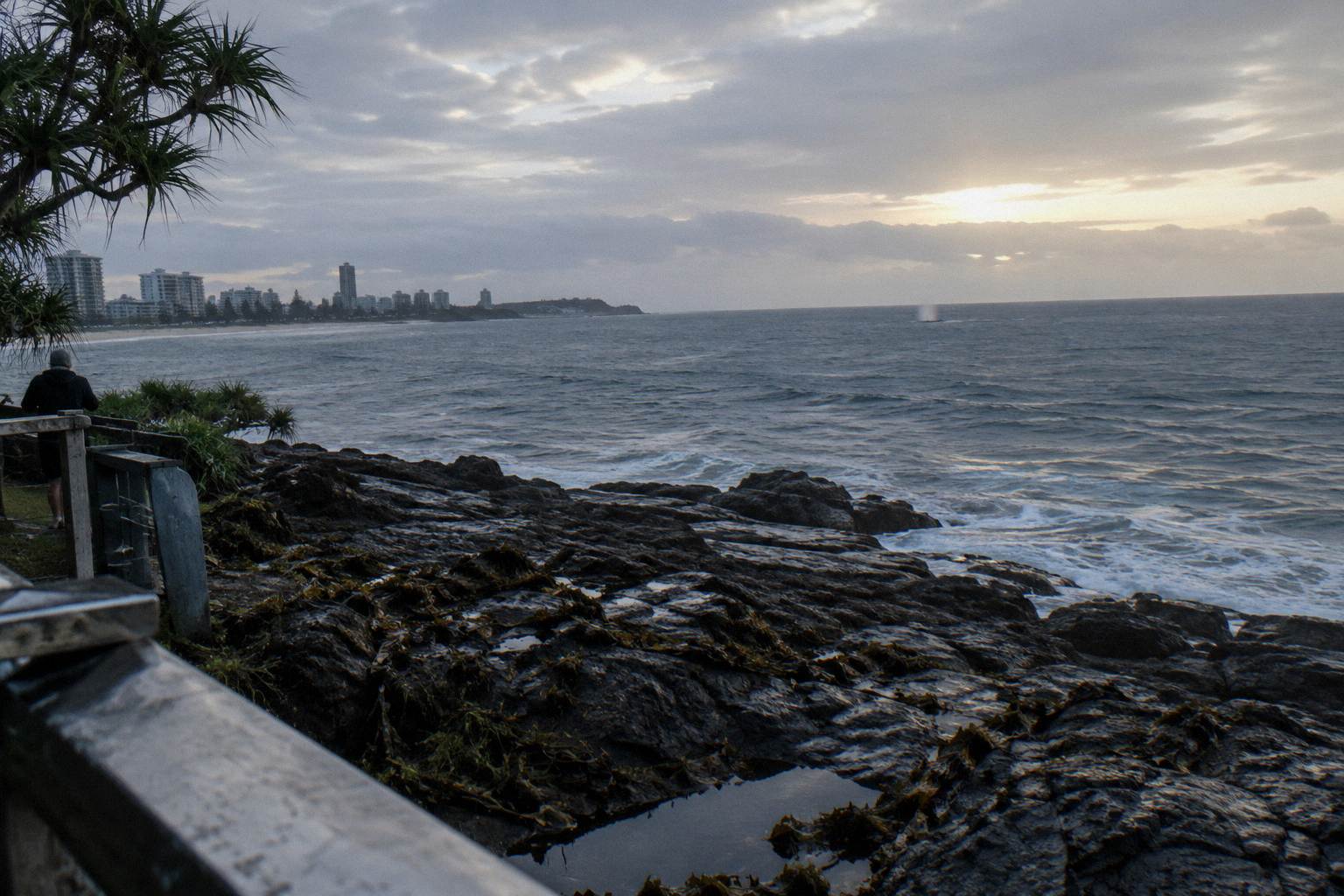
Short answer
Whale season on the Sunshine Coast runs roughly June to October, into early November. Visit Sunshine Coast calls June to November the official season, while operator windows differ: Adventure Rafting runs 1 June to 31 October, and Whale One tours run until very early November. Northbound whales pass from May to July and southbound from July to August.
When Does Whale Season Run On The Sunshine Coast?
Whale season on the Sunshine Coast runs roughly June to October, into early November, and the spread between those two end points is real: the tourism body, the operators and the scientific measurements each describe the window slightly differently. Visit Sunshine Coast calls June to November the official season. The Queensland Government describes the migration itself as northbound between May and July, with whales turning south in July and August. Whichever month you pick, the guide to actual whale sighting odds on a watching tour explains what season timing and operator sighting policies reveal before you book.
The reason the season feels slippery is that it is not one event. It is two passing streams: whales heading north to tropical breeding grounds, then the same animals, with new calves, heading back south. The Queensland Government states it plainly: "Generally, humpback whales migrate northwards along the Queensland coast between May and July. After a spending some time in tropical breeding grounds, they turn south in July and August." A boat that leaves Mooloolaba in late September is watching the southbound leg, not the northbound one, and the whales behave accordingly.
For a reader fixing trip dates, that means the month you choose shapes the kind of trip you get: which direction the whales are travelling, how the population figures line up with the peak measurements, and what the weather averages look like at the nearby airport station. None of the sources promises a sighting in any month, and no month is measurably best at Mooloolaba itself, because no Mooloolaba-measured peak exists. What exists is a set of dated statements from official, tourism and scientific sources, and a climate record, which together give a fair picture of each month.
The population backdrop helps too. The Queensland Government puts the eastern Australian humpback population at around 50,000, growing from roughly 12,000 in 2008 at about 10 percent a year, which is why a coast that once saw thin traffic now has boats running seven days through spring. The last peer-reviewed survey counted 24,545 whales in 2015, with long-term growth of about 10.9 percent a year through 2015. More detail on the migration itself is in the humpback migration guide for the coast.
What The Sources Say About Season Dates
No two season statements agree exactly, and the differences are worth knowing before you book: Visit Sunshine Coast says June to November on its FAQ page but "to the end of October" on its guide page, Adventure Rafting runs 1 June to 31 October, and Whale One tours run from early June until very early November. Each statement comes from its own page, and each applies to its own product or region.
The Queensland Government does not publish a Sunshine Coast season at all; it describes the migration timing, northbound May to July and turning south in July and August, on its whale watching page. Visit Sunshine Coast, the regional tourism body, frames it as a visitor season: "Official whale season is from June to November here on the Sunshine Coast", and adds that July and August carry the largest northbound numbers past the coast. The scientific measurements are narrower and more specific: a northbound peak off south-east Queensland in late June to early July measured at Point Lookout, and a southbound adult peak at Peregian Beach on the Sunshine Coast that has moved from early October before 2015 to mid-September by 2023 and 2024.
| Source | Season or timing statement | Applies to |
|---|---|---|
| Queensland Government | Northbound May to July; turn south July and August | The migration along the Queensland coast |
| Visit Sunshine Coast FAQ | "Official whale season is from June to November here on the Sunshine Coast" | The Sunshine Coast tourism region |
| Visit Sunshine Coast guide page | Season "typically runs all the way through to the end of October" | The Sunshine Coast tourism region |
| Sunreef and Whale One | Season runs from early June, tours until very early November | Sunreef and Whale One trips from Mooloolaba |
| Adventure Rafting | 1 June to 31 October, seven days | Adventure Rafting trips from Mooloolaba |
| Peer-reviewed survey | Southbound adult peak at Peregian mid-September by 2023 and 2024; northbound peak off south-east Queensland late June to early July | Measured survey points, not a season window |
The practical reading is simple. The core of the season, the window every source covers, is June through September. The edges, late May, October and the first days of November, are where the sources diverge, and where your choice of operator matters, because a late-October booking sits inside one operator's season and outside another's.
The comparison question, which trip suits which traveller, is covered in more depth in the whale watching tours compared guide. For season planning the short version is that cruise trips run the full operator window, while the swim season is shorter, which is the subject of a later section below.
Whale Season Month By Month
Each month from June to November has a documented character built from the migration timing, the operator windows and Bureau of Meteorology averages: June and July carry the northbound stream, August and September the crossover between directions, and October into early November the tail of the southbound run. The table below lists what each source actually says, plus the long-run climate averages at the nearby airport station.
These are statements and averages, not a sighting forecast. No source can tell you what a given day in a given month will show, and conditions offshore differ from the beach, as the operators themselves note.
| Month | Migration and source statements | Mean max / min (C) | Mean rain (mm) | Rain days 1 mm or more |
|---|---|---|---|---|
| June | Northbound migration under way; Point Lookout northbound peak late June to early July off south-east Queensland; season opens, Sunreef from early June, Adventure Rafting from 1 June | 21.5 / 11.3 | 104.6 | 8.9 |
| July | Visit Sunshine Coast: largest northbound numbers in July and August; southbound turn begins per the Queensland Government; Swim With Humpback Whales season opens, Sunreef statement "July to Mid October" | 21.2 / 9.7 | 69.4 | 6.9 |
| August | Both directions passing: Sunreef calls August and September the "crossover period"; Queensland Government southbound movement in July and August | 22.3 / 10.1 | 73.2 | 5.6 |
| September | Peregian southbound adult peak mid-September by 2023 and 2024; crossover continues; driest month in the long-run averages | 24.3 / 13.0 | 50.7 | 5.4 |
| October | Southbound run finishing; Sunreef says "most whales will be finishing their journey south" from September to end of October; Adventure Rafting season closes 31 October; swim season closes mid October | 25.7 / 15.8 | 99.6 | 7.5 |
| November | Edge of the season: Whale One tours run "until very early November"; Visit Sunshine Coast FAQ names November as the official end; most operators have closed | 27.3 / 18.0 | 84.8 | 7.5 |
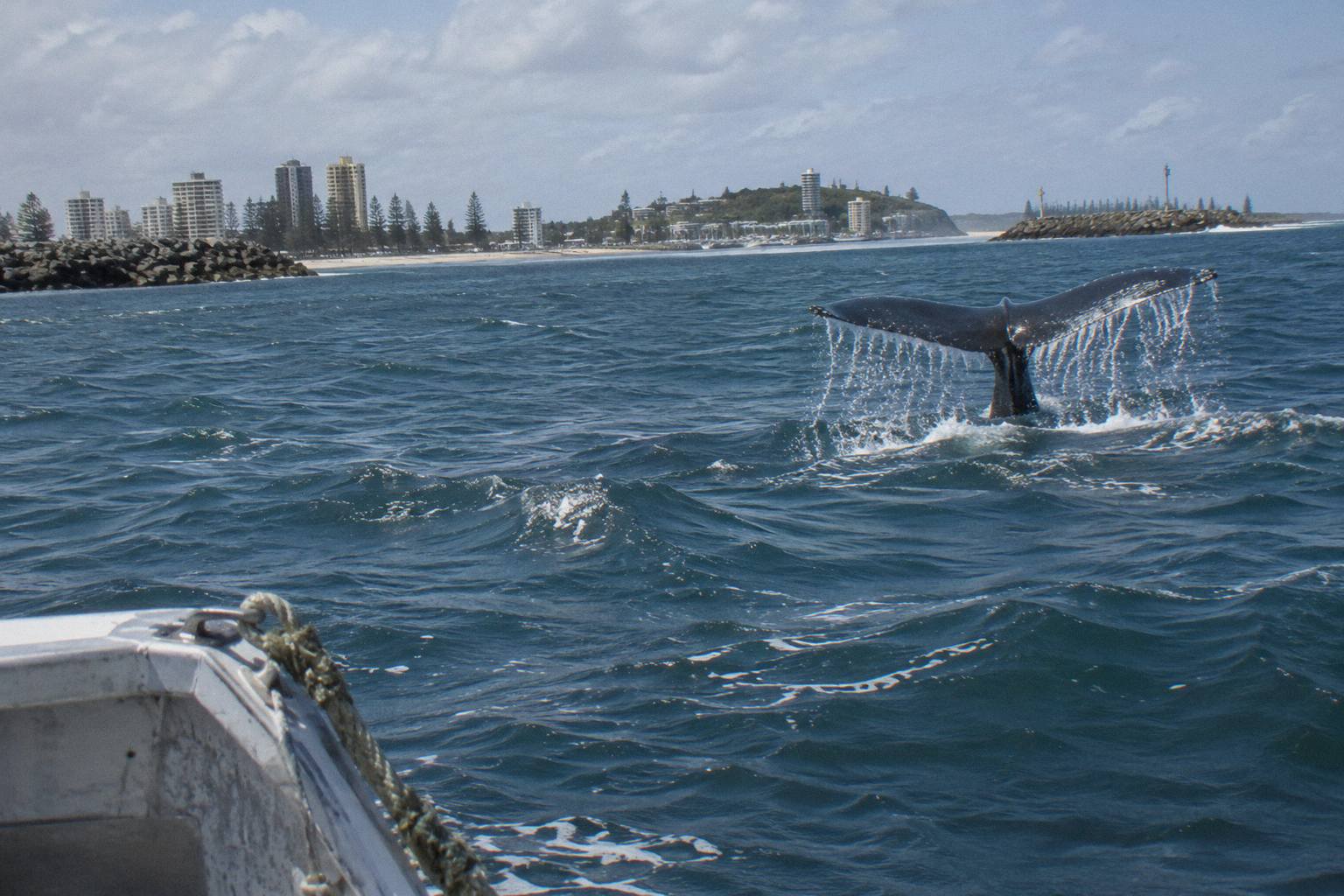
June is the opening month, and it opens in stages. The migration has been under way since May further north in the stream, but the coast's boats start in the first days of the month: Adventure Rafting from 1 June, Sunreef from early June. The measured northbound peak off south-east Queensland, late June to early July, comes from Point Lookout survey data, south of Mooloolaba, and is the one hard number attached to the early season. The climate averages at the nearby airport station put June at a mean maximum of 21.5 degrees and a mean minimum of 11.3, with 104.6 mm of rain over 8.9 rain days, the wettest of the season months.
July is the month the tourism body singles out. Visit Sunshine Coast pairs July with August as the time "the largest numbers are passing by as they head north". It is also when the swim season opens: Sunreef states its Swim With Humpback Whales season runs from July to mid October. July carries the lowest mean maximum of the season, 21.2 degrees, and the mean minimum drops to 9.7, so warm layers belong in the bag, a point the what to wear on a whale cruise guide covers in detail.
August is the crossover month in the operators' own words. Sunreef describes June and July as the northbound stretch, and says that in August through September many whales go both north and south in what the operator calls the 'crossover period'. The Queensland Government's southbound movement, July and August, is under way. The long-run averages are kind: 5.6 rain days of 1 mm or more, on 73.2 mm total.
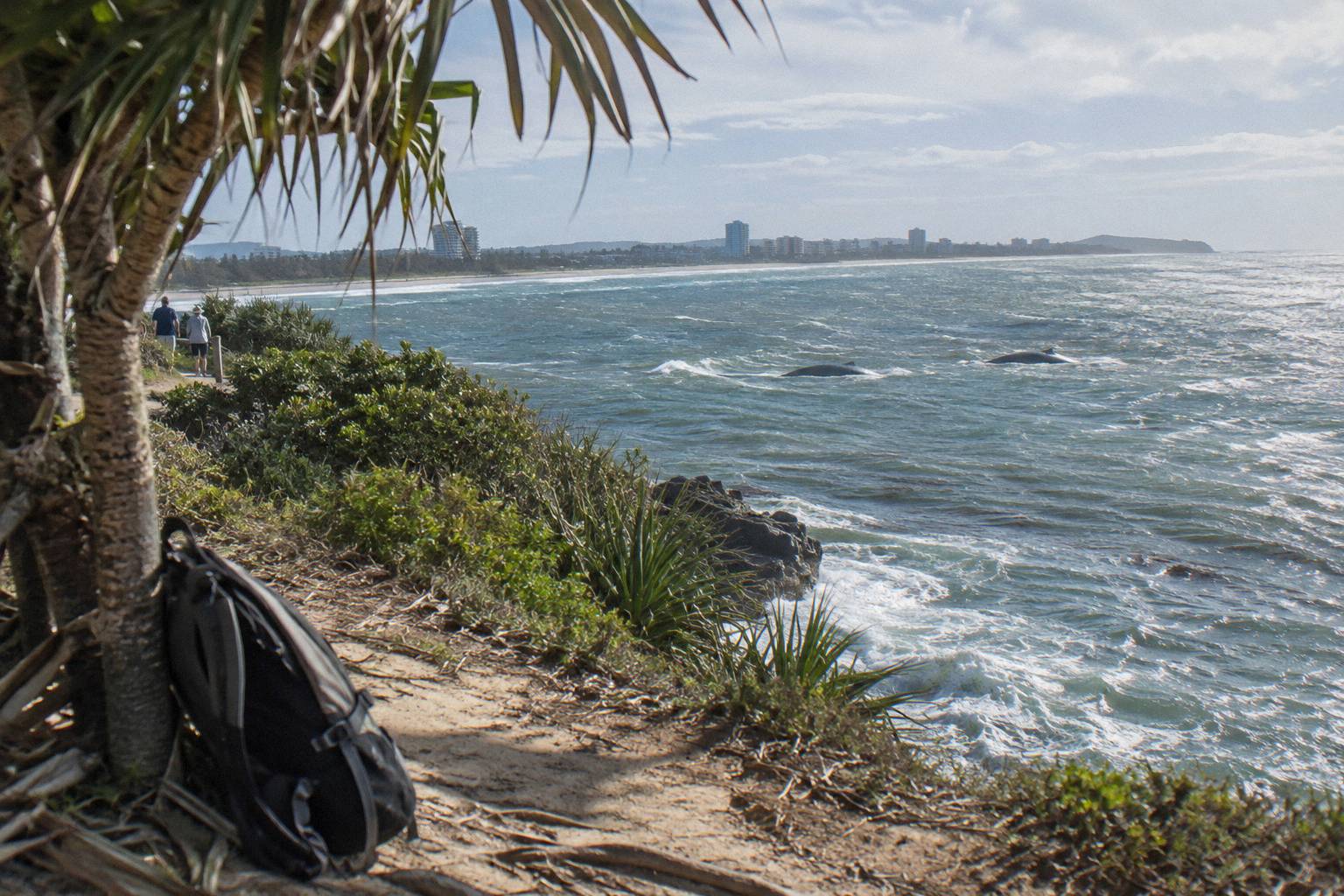
September is when the measured southbound peak arrives at Peregian Beach on the Sunshine Coast. The peer-reviewed finding is that adult southbound peaks, "early-October pre-2015, moving forward to mid-September by 2023 and 2024" (the Scientific Reports paper is open access). That shift matters for planning: the southbound peak a decade ago sat in early October, and the recent measurements put it two to three weeks earlier. September is also the driest month in the climate averages, 50.7 mm over 5.4 rain days.
October is a month of two endings. The cruise season runs to its close, Adventure Rafting to 31 October, with Sunreef expecting that "from September to the end of October, most whales will be finishing their journey south". The swim season closes earlier, mid October by the Sunreef statement. The rain averages pick up, 99.6 mm over 7.5 rain days, while the mean maximum climbs to 25.7 degrees.
November barely exists as a whale month. Whale One tours run "until very early November", and the Visit Sunshine Coast FAQ names November as the official end of the season, but the cruise boats have stopped and the whales are, in the operator's words, finishing their journey. A November booking is a gamble on the first days of the month at most, on one operator's product only.
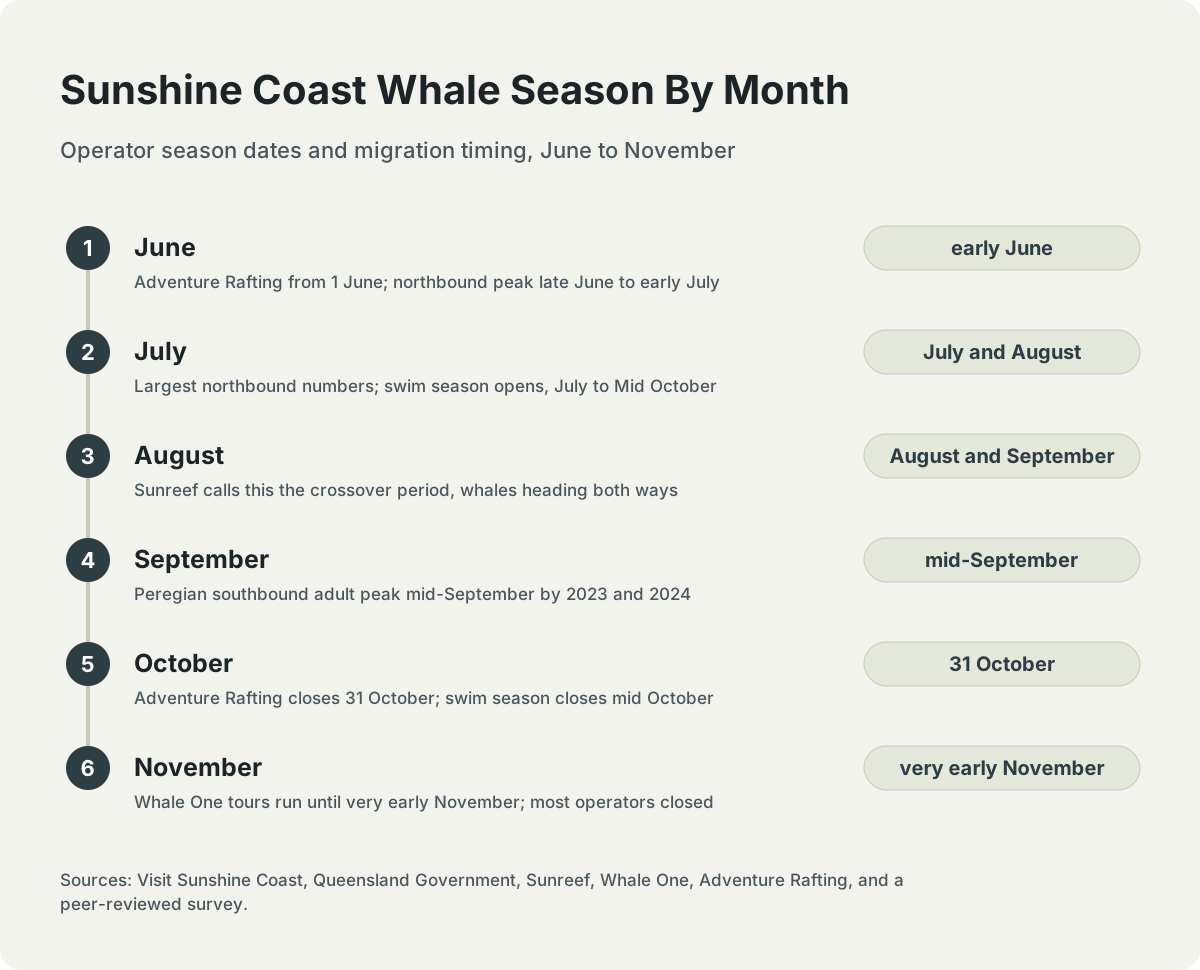
If your dates are still flexible, the core months, July to September, sit inside every operator's window, carry the tourism body's largest-numbers statement and the measured southbound peak, and hold the driest stretch of the long-run climate record. That is a statement about what the sources say, not a promise about any given day.
Cruise Season Versus Swim Season
The swim season is shorter than the cruise season: Sunreef states its Swim With Humpback Whales season runs from July to mid October, while its cruise season runs from early June until very early November with Whale One. That is a six-week gap at the start of the season and roughly three weeks at the end, and it decides which product a date in June or late October can actually book.
A June date can book a cruise but not a swim. A late October date can book a cruise, while the swim season has closed. Only the July to mid October overlap serves both, and the choice between them is bigger than a calendar question: the cruise is a three-hour boat trip from A$89 per person, while the swim trip is a four-hour in-water experience from A$269 per person, amounts in Australian dollars. The fuller trade-off, including what swimming actually involves, is in the cruise or swim with whales comparison.
| Product | Season window (operator statement) | Duration | From price per person |
|---|---|---|---|
| Sunreef 3-Hour Whale Cruise | Early June to very early November, with Whale One | 3 hours | from A$89 |
| Fast Boat, Free Cancellation | 1 June to 31 October, Adventure Rafting | 2 hours | from A$115 |
| Swim With Humpback Whales | July to mid October, Sunreef statement | 4 hours | from A$269 |
Swim programmes are run by operators, and the operator's own rules apply on the day. Sunreef states that its encounters follow the Australian National Guidelines for Whale and Dolphin Watching. The in-water rules themselves, including the Queensland distance limits for a person in the water, are set out in the swim with whales rules and safety guide.
The date question interacts with price. Every trip here shows free cancellation on the booking page, so an early booking in a shoulder month holds the date while the season firms up. Whether early booking is needed at all is a separate question with its own answer in do you need to book whale watching in advance.
Why The Sources Disagree On The End Month
The end of the season differs because each source is measuring a different thing: the tourism FAQ rounds the season to a calendar boundary, the operator pages state their own sailing dates, and the science measures when adult whales actually pass a survey point. Visit Sunshine Coast says June to November on one page and end of October on another; Whale One says very early November; the measured southbound peak is mid-September.
None of these statements is wrong. The FAQ's "June to November" is a regional visitor frame, generous at the edges. The operator windows are commercial schedules: boats stop sailing when the passenger demand thins, which tracks but does not equal the passing whales. The measurements are biology: adults passing Peregian peak by mid-September, which means the densest southbound traffic is over well before any of the published end dates. Even one operator's own pages can conflict: Adventure Rafting's site states 1 June to 31 October while its booking page closes earlier, on 20 October.
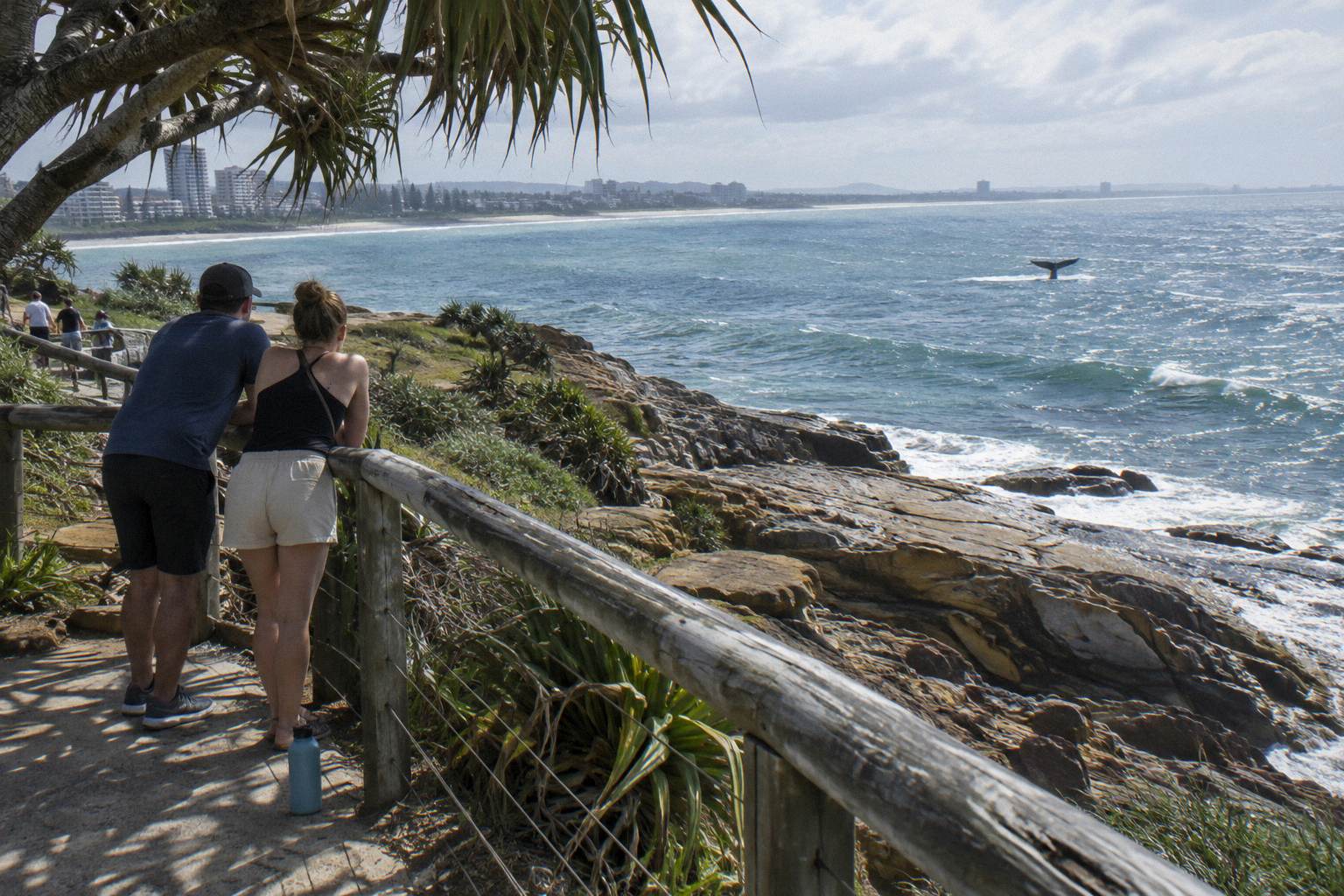
For a reader, the practical rule is to trust the operator's own current season dates for the trip you are booking, and treat every broader season statement as background. A 25 October date inside the "June to November" tourism frame may find no boat sailing at all. A 5 October date is comfortably inside every window. The taper is steep at the end: the whales finishing their journey south through October are the rear of the southbound stream, and the scientific finding that the peak has moved forward to mid-September means the strongest numbers pass earlier in the season than they once did.
How To Pick Your Month
Match the month to what you want from the trip: July and August for the largest northbound numbers per Visit Sunshine Coast, September for the measured southbound peak at Peregian and the driest climate averages, June for the season opening with the Point Lookout northbound peak arriving late in the month, and October for a quieter, warmer tail of the run.
By traveller type, the logic separates cleanly. Families balancing school holidays land on late June to July or late September, both inside the school breaks, both inside every window, with the northbound peak arriving off south-east Queensland in late June to early July. Photographers chasing the densest passing traffic read the measurements: the mid-September southbound peak at Peregian and the July and August northbound statement. Swimmers have the narrowest window, July to mid October, and the earliest closing date of any product. Travellers who hate rain read the climate table: September is driest at 50.7 mm over 5.4 rain days, July and August both sit under 6.9 rain days, and October nearly doubles September's rain.
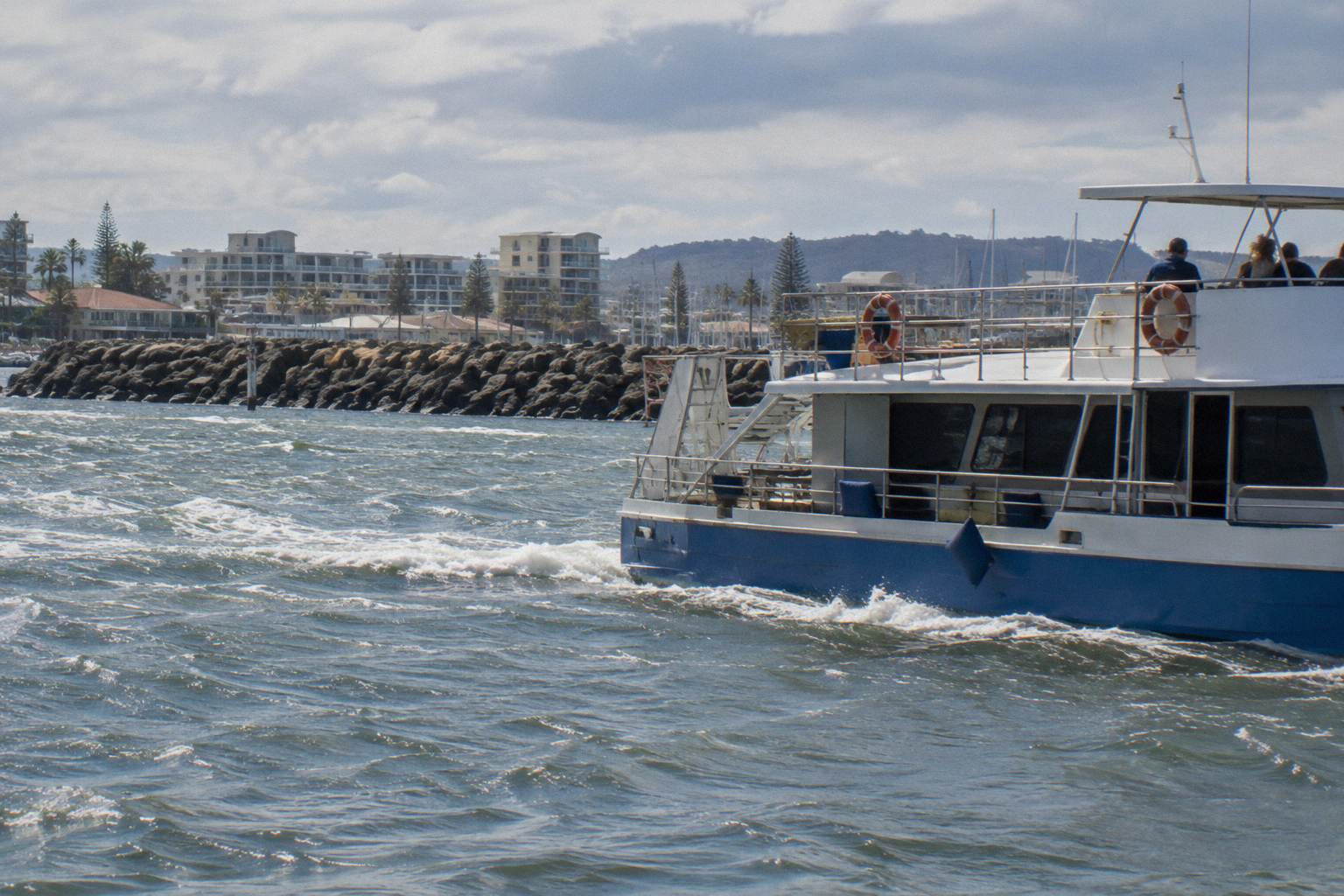
The trip choice then follows the date. The Sunreef 3-Hour Whale Cruise, rated 4.3 from 200+ reviews, runs the full early June to early November window at from A$89 per person, making it the date-proof option for edge months; its Sunreef 3-Hour Whale Cruise link shows the departures for your dates. The Sunreef 3-Hour Whale Cruise page carries the meeting point and cancellation detail. For a shorter, faster format, Adventure Rafting's fast boat whale trip, rated 4.6 from 100+ reviews and from A$115 per person, runs the same June to October window in two hours. For the date that only a swimmer can use, mid July to mid October, the swim trip fills it.
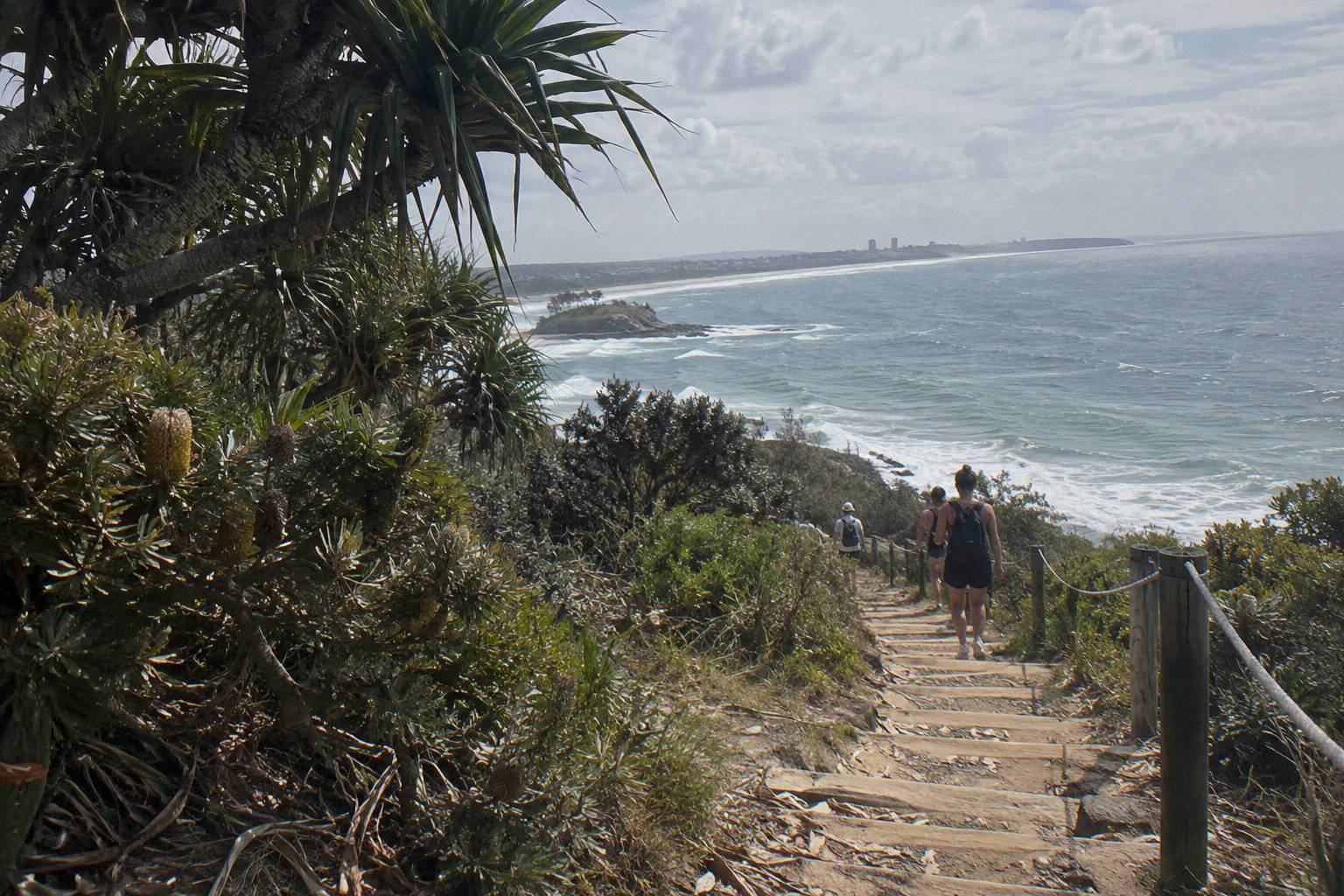
One thing no month planning should lean on is the white whale. The Queensland Government notes that white whale sightings are rare and not guaranteed each season, and no trip is built around one. Equally, no month changes the legal approach distances that govern every boat, from the 100 m no approach zone to the 300 m caution zone, set out on the Queensland rules for watching marine mammals page.
What Trips People Up When Booking Dates
Three date mistakes come up again and again: booking a November date on the strength of a June to November tourism statement and finding the boats have stopped, assuming every operator's season ends the same month, and booking a June or late October swim date when the swim season only runs July to mid October. Each is avoidable by checking the operator's own dates before paying.
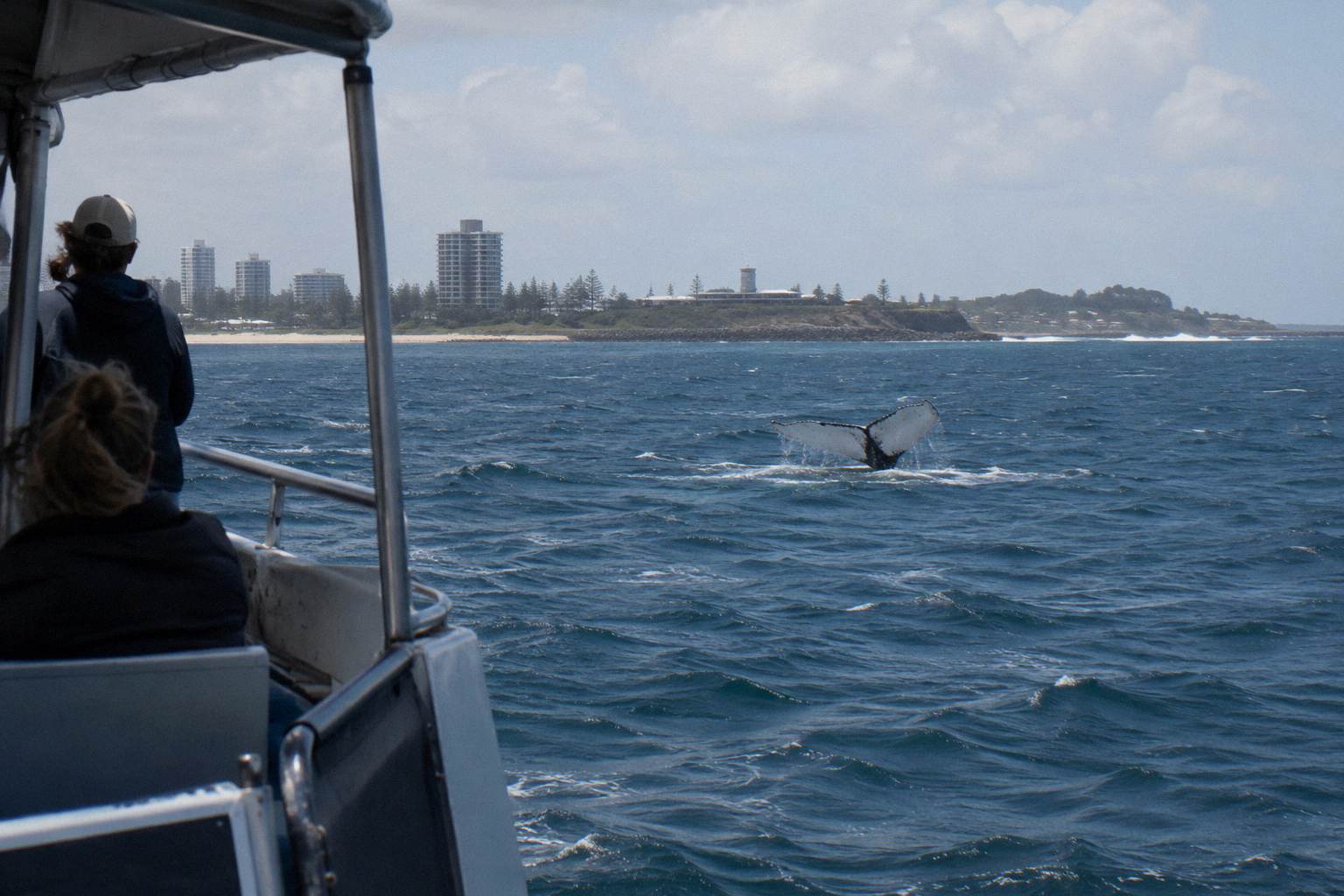
The first mistake is trusting the widest frame. The "June to November" line is a regional statement, not a sailing schedule, and only one operator's product reaches very early November. The second is assuming uniform seasons: Adventure Rafting closes 31 October, its own booking page says 20 October, and Whale One runs to very early November; these are different products with different calendars, and a date that suits one may not suit another. The third is mixing up cruise and swim windows: the swim season opens about six weeks after the cruises and closes about three weeks before the last cruise sailings.
| Mistake | What actually happens | Fix |
|---|---|---|
| Booking from the tourism FAQ's end month | Boats may have finished for the season by then | Check the operator's own season dates on the booking page |
| Assuming one season window fits all trips | Operators state different end dates, and one operator's own pages conflict | Compare the season windows table above |
| Booking a swim date outside July to mid October | The swim product is not running in June or late October | Book the cruise instead, or shift the swim date |
| Treating a peak measurement as a sighting promise | No month or measurement means a whale will appear on the day | Hold dates with a free cancellation trip and stay flexible |
Weather is the fourth trap, in a different way. The long-run averages at the nearby airport station (Bureau of Meteorology table) describe the month, not your day, and the operators note that conditions offshore differ from the beach. Every trip in the trip list offers free cancellation on the booking page, and operators cancel and rebook or refund when weather stops a sailing. If rough-weather questions weigh on the choice, the whale watching weather and sea conditions guide works through them.
Before locking a date, it is worth asking any operator the same short list: what are your own season dates for the coming year, what happens if the sailing is cancelled for weather, what is the departure time for the date in question, and is there any age or condition rule that applies to the travellers in the group. The answers differ by operator, and each operator's own page is the source that counts.
Whichever month wins, the three ways to be on the water from Mooloolaba are below: the full-window cruise, the two-hour fast boat, and the July to mid October swim.
The season on the whole coast is the wider frame, and the month you choose for Mooloolaba Whale Watching fits inside the same June to early November arc that shapes every departure point between Noosa and the Gold Coast.
For the swim window specifically, mid July to mid October, the four-hour trip below is the product that runs it, and its booking page shows the price for your date alongside the season calendar.
And for the date-proof choice that spans the entire season from early June to early November, the three-hour cruise fits every month in the tables above, with free cancellation on the booking page.
Common Questions About The Sunshine Coast Whale Season
When Is Whale Season On The Sunshine Coast?
Roughly June to October, into early November. Visit Sunshine Coast states June to November as the official season, Sunreef and Whale One run from early June to very early November, and Adventure Rafting runs 1 June to 31 October. The operators disagree on the end month, so check the operator's own dates for your trip.
What Is The Best Month To See Whales On The Sunshine Coast?
No month is measurably best at Mooloolaba, because no Mooloolaba-measured peak exists. Visit Sunshine Coast says July and August carry the largest northbound numbers, and the measured southbound adult peak at Peregian Beach falls in mid-September by 2023 and 2024. July to September sits inside every operator's window.
Do The Whales Pass Twice?
Yes, in two streams. The Queensland Government describes northbound migration between May and July and the southbound turn in July and August. Sunreef calls August and September the crossover period, when whales pass in both directions.
Can You Swim With Whales In June?
No. Sunreef states its Swim With Humpback Whales season runs from July to mid October, so June dates can book a cruise but not a swim. The swim season also closes well before the last cruise sailings in late October.
Are Whales Still Around In November?
Barely. Whale One tours run until very early November, and the Visit Sunshine Coast FAQ names November as the official season end, but the cruise boats have largely stopped and Sunreef expects most whales to have finished their southbound journey by the end of October.
Which Month Has The Best Weather For A Whale Cruise?
By long-run averages at the nearby airport station, September is the driest season month, with 50.7 mm of rain over 5.4 rain days, and July and August also average fewer than seven rain days. Averages describe the month, not your day, and operators cancel and rebook or refund when weather stops a sailing.